
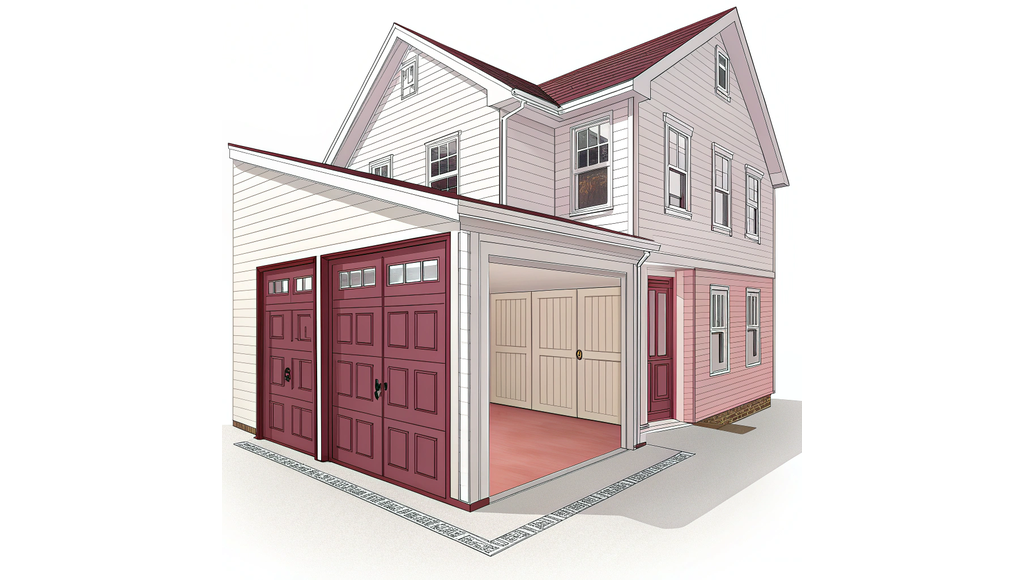
You got three quotes for a new garage door, and the prices are all over the map. One contractor says $1,100 for a steel door. Another wants $2,800 for what looks like the same thing. The third is pushing a wood door at $4,200. What's actually fair here?
The answer depends almost entirely on two factors: what the door is made of and how big your garage opening is. These two variables account for most of the price differences you'll see between quotes. Once you understand how materials and sizes affect cost, those wildly different numbers start making sense.
Quick Insight: A basic steel door for a single-car garage averages $600 to $1,500 installed, while a premium wood door for a two-car garage can easily hit $3,000 to $5,000 with the same installation crew.
Here's how material choice and door size actually break down in real costs, so you can tell whether you're getting a fair quote or getting taken for a ride. For a complete picture of all cost factors beyond just material and size, check out the full installation cost estimator guide.
How Material Choice Drives Your Installation Cost
Material selection accounts for 60 to 70 percent of your total installation cost. This isn't just about aesthetics. Different materials have different manufacturing costs, durability ratings, and installation requirements. A steel door costs less to produce and ship than a custom wood door, and that savings gets passed to you.
The five main garage door materials span a huge price range. Steel dominates because it balances affordability with decent durability. Wood costs triple what steel does but delivers curb appeal that steel can't match. Aluminum sits in the middle for coastal homes where rust matters. Composite materials try to give you wood's look without wood's maintenance headaches.
Climate affects material performance too. Steel doors without insulation rust faster in humid areas. Wood warps in temperature swings. If energy efficiency matters because your garage shares a wall with living space, adding insulation to any material adds $200 to $500 to your cost. For detailed comparison of how insulation affects pricing, see the insulated vs non-insulated cost breakdown.
| Material | Cost Range | Typical Lifespan | Maintenance Level | Best For |
|---|---|---|---|---|
| Steel | $650–$3,200 | 15–20 years | Low (occasional paint touch-up) | Budget-focused, everyday use |
| Aluminum | $600–$2,900 | 12–18 years | Very low (rust-proof) | Coastal areas, modern styles |
| Vinyl | $800–$2,500 | 15–25 years | Very low (weather-resistant) | Humid climates, minimal upkeep |
| Wood | $900–$4,500 | 20+ years | High (annual sealing/staining) | Premium homes, curb appeal priority |
| Composite | $650–$4,800 | 18–25 years | Low to medium | High-end look, less maintenance |
Steel and Aluminum Doors for Budget-Conscious Buyers
Steel doors range from $650 to $3,200 depending on gauge thickness, insulation, and finish quality. An uninsulated 24-gauge steel door for a single-car garage starts around $650 installed. Step up to insulated 16-gauge steel with a wood-grain texture, and you're looking at $1,800 to $2,400 for the same size opening.
The insulation question matters here. Uninsulated steel saves you $400 to $600 upfront but costs more in energy bills if your garage is attached. Insulated steel also resists denting better because the foam core adds rigidity. If you park close to the door or have kids playing near the garage, that dent resistance pays off.
Aluminum doors cost $600 to $2,900 and make sense in specific situations. They don't rust, which matters in coastal areas where salt air eats steel. They're lightweight, making them easier on openers and springs. But they dent easily, so skip aluminum if you're prone to bumping the door with your car.
Reality Check: A cheap $650 steel door might need replacement in 8 to 10 years, while a $1,500 insulated steel door lasts 20 years. That works out to $81 per year vs $75 per year, making the better door cheaper over time.
The gauge number matters more than most people realize. Lower gauge numbers mean thicker steel. A 16-gauge door is noticeably sturdier than a 24-gauge door. If durability matters, spend the extra $200 to $400 for lower-gauge steel.
Premium Materials and When They Make Sense
Wood doors start at $900 for basic single-car options and climb to $4,500 for custom carriage-house styles on double garages. That's three to four times what steel costs. You're paying for natural beauty and customization options that steel can't replicate. Every wood door can be stained or painted to exact specifications.
But wood demands maintenance. Plan on $150 to $300 annually for sealing or staining to prevent warping and rot. Over a 20-year lifespan, that maintenance adds $3,000 to $6,000 to your total cost. If you're not willing to commit to that schedule, wood becomes expensive frustration.
Composite and faux-wood options cost $650 to $4,800 and split the difference. These doors use steel or fiberglass cores with wood-textured overlays. You get wood's appearance without the warping and maintenance issues. Expect to pay 10 to 25 percent more than comparable steel doors for this convenience.
Fiberglass and vinyl doors ($800 to $2,700) work well in harsh weather regions. Fiberglass resists impacts better than aluminum and won't rust or warp. Vinyl handles humidity and temperature swings without maintenance. Both sacrifice some aesthetic options compared to wood or high-end steel, but they deliver reliable performance in tough climates.
Premium materials make financial sense when curb appeal directly affects home value. If you're selling a $500,000+ home, a $4,000 wood door might return $6,000 to $8,000 in perceived value. For a rental property or home you're keeping long-term, steel usually makes more sense.
Size-Based Cost Breakdown and Installation Impact
Single-car garage doors typically measure 8x7 or 9x7 feet and cost $500 to $3,000 installed depending on material. Double-car doors run 16x7 or 16x8 feet and cost $800 to $5,000. Notice that doubling the width doesn't quite double the cost. The labor and hardware scale up, but not proportionally.
The wider span of a double door requires heavier-duty torsion springs and reinforced tracks. Springs for a 16-foot door cost $100 to $150 more than springs for an 8-foot door. Track systems need extra support brackets. If you're adding an opener, double doors typically need 3/4 HP motors instead of 1/2 HP, adding another $100 to $200.
Custom sizes outside standard dimensions add 20 to 40 percent to your cost. If your garage opening is 10 feet wide or 9 feet tall, the door gets manufactured to order instead of pulled from inventory. Lead times stretch from 1 week to 3 to 4 weeks, and the price reflects that customization premium.
| Garage Size | Dimensions | Steel Cost Installed | Wood Cost Installed | Aluminum Cost Installed |
|---|---|---|---|---|
| Single-car | 8x7 to 9x7 ft | $650–$1,800 | $1,200–$3,200 | $800–$1,900 |
| Double-car (one door) | 16x7 to 16x8 ft | $1,000–$2,800 | $2,500–$4,500 | $1,400–$3,200 |
| Double-car (two doors) | Two 8x7 or 9x7 ft | $1,400–$3,200 | $2,800–$5,600 | $1,800–$3,600 |
| Custom oversized | 10x8 ft or larger | $1,800–$4,200 | $3,500–$7,000 | $2,200–$4,800 |
Smart Move: Installing two single doors instead of one double door costs more upfront but gives you flexibility. If one door fails, you still have access. For garages with two separate vehicles, this setup makes daily use easier.
Three-car garages typically use either three single doors or one double plus one single. Three singles run $1,700 to $7,200 total depending on material. This setup maximizes flexibility but increases labor costs because you're essentially doing three separate installations.
Making Your Material and Size Decision
Your material and size choice should match both your budget and your actual needs. A $4,000 wood door on a detached garage you rarely use wastes money. A $700 uninsulated steel door on an attached garage in Minnesota costs you in heating bills.
Start by measuring your current opening and determining whether you need standard or custom dimensions. Standard sizes save 20 to 40 percent and ship faster. Then match material to your climate, maintenance tolerance, and aesthetic priorities. Steel works for most situations. Wood makes sense when curb appeal affects home value. Aluminum fits coastal areas. Composite splits the difference when you want wood's look without the work.
When you request quotes from contractors, provide these specifics upfront. Knowing your size and preferred material helps installers give accurate estimates instead of rough guesses. Get at least three quotes and compare not just the total but what material grade and warranty each includes. For help choosing contractors who provide transparent pricing, see the guide on how to choose a reliable garage door company.
If you're replacing both the door and opener, factor in opener installation costs for your complete budget. A quality opener adds $400 to $800 but significantly affects daily convenience and security.
FAQs
How much does a steel garage door cost compared to wood?
Steel garage doors range from $650 to $3,200 installed, while wood doors cost $900 to $4,500. Steel offers better value for most homeowners with minimal maintenance needs. Wood costs three to four times more upfront and requires $150 to $300 annually for sealing or staining to prevent warping and rot, adding thousands over its lifespan.
Does a double garage door cost twice as much as a single door?
Double garage doors don't cost exactly twice as much as single doors. A single steel door runs $650 to $1,800, while a double costs $1,000 to $2,800. The wider span requires heavier springs and reinforced tracks, but labor doesn't double. You'll pay about 50 to 70 percent more rather than 100 percent more for the larger size.
Are custom size garage doors much more expensive than standard sizes?
Custom garage doors cost 20 to 40 percent more than standard sizes. Standard dimensions like 8x7 or 16x7 feet ship from inventory within a week. Custom sizes get manufactured to order, adding three to four weeks to lead time. If your opening matches standard dimensions, you'll save hundreds and get faster installation.
Is insulated steel worth the extra cost over uninsulated?
Insulated steel doors cost $400 to $600 more than uninsulated but deliver better value long-term. They resist denting better because foam core adds rigidity. If your garage shares a wall with living space, insulation cuts energy bills. Over 15 to 20 years, the energy savings and durability often offset the upfront premium.
- garage door cost by material
- garage door size pricing
- new garage door cost
- garage door replacement cost